Why Marketing Isn’t a Magic Wand (And What Actually Matters)
Think marketing is a magic wand you wave over a bad product to make it fly? Think again.

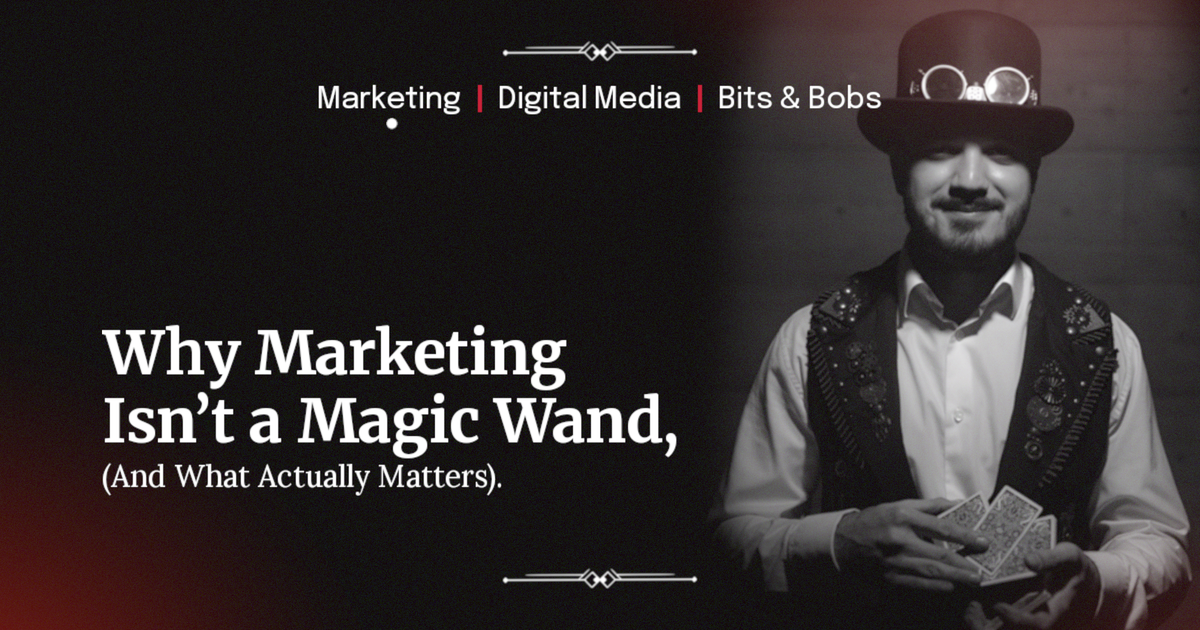
There’s this unspoken belief that if you just “do more marketing”—more campaigns, more posts, more buzz—you can fix anything. But if the basics are off, all that noise just makes the cracks louder.
When “More Marketing” Makes Things Worse
A while back, there was this brand that decided marketing was the missing piece. They threw money at campaigns, visuals, slogans, the lot. On paper, it all looked impressive. In reality? The product was weak, the price didn’t make sense, and the whole positioning was, as we’d say here, all over the shop.
They kept tweaking the campaign.
They kept changing headlines.
They kept asking for “something punchier.”
But no matter how clever the tagline or how polished the visuals, nothing stuck. People might have clicked out of curiosity, but they didn’t stay, and they definitely didn’t buy.
Not because the marketing team didn’t try.
Because the foundation wasn’t there.
It’s like pouring the perfect pint… into a cracked glass. No amount of foam art is saving that.
Marketing Is Just Storytelling (With Truth at the Core)
Here’s the part a lot of people skip: marketing, at its core, is storytelling. Not in a fluffy, inspirational-quote way—but in a very practical one.
You’re telling people:
- What this thing is.
- Who it’s for.
- Why it matters in their life.
If the story underneath is shaky—product’s naff, price is bonkers, brand is confused—your marketing becomes exaggerated fiction. And people can smell that from a mile away.
Good marketing doesn’t invent a story.
It reveals and amplifies a true one.

The Boring Stuff That Actually Moves the Needle
Before thinking about “How do we promote this?”, it’s worth sitting with a few uncomfortable but necessary questions:
- Product: Is this actually good? Would someone recommend it without being paid or prompted?
- Price: Does it feel fair for what it offers? Not just compared to competitors, but to the person’s reality.
- Positioning: Is it clear who this is for and why it’s different? Or could it belong to any random brand?
When a brand ignores these and runs straight to “Let’s get the word out!”, they’re not doing marketing. They’re doing damage control.
A Simple Filter: Would You Believe Your Own Campaign?
Here’s a useful gut check:
If you stumbled on your own campaign as a stranger, would you believe it?
If not, it’s usually not the visuals or the slogan that need changing. It’s the offer itself, or the way it’s framed in the real world.
Marketing works best when it feels like someone is finally saying out loud what you already feel, want, or need. That only happens when the brand deeply understands:
- The problem it solves.
- The person it’s speaking to.
- The context they’re living in.
How to Get Your Basics Right Before You Turn Up the Volume
If this all feels a bit abstract, here’s a practical way to bring it down to earth.
1. Start Where It Hurts
Ask: “If no one ever saw a campaign from us again, would the product still be worth talking about?”
If the honest answer is “not really”, that’s where the work begins. Improve:
- Quality
- Usability
- Reliability
before shouting about it.
2. Sense-Check Your Price
Sit with someone from your actual audience and say the price out loud. Watch their face.
If they flinch, go quiet, or change the subject, something’s off.
You can:
- Add more value.
- Adjust the price.
- Refine who it’s for.
But pretending it’s fine and slapping “LIMITED OFFER” on top won’t fix it.
3. Make Your Positioning Stupidly Clear
Someone should be able to answer in one sentence:
- “This is for people who ___.”
- “It helps them ___.”
If your explanation sounds like a pitch deck instead of a simple sentence, it’s too vague. Clarity is magnetic. Confusion is expensive.

Where Marketing Finally Starts to Shine
Once the basics are in place - solid product, fair price, clear positioning - then marketing stops feeling like a rescue mission and starts feeling like momentum.
Now your campaigns:
- Echo real customer experiences.
- Amplify genuine value.
- Attract people who actually need what you offer.
You’re no longer using marketing to hide the gaps. You’re using it to highlight the good work you’ve already done.
Your Turn: Fix This First
Before planning your next big campaign, try this:
- Grab a notebook.
- Write three headings: Product, Price, Positioning.
- Under each, list what you’re genuinely proud of—and what makes you uneasy.
Anywhere you feel that little twinge of discomfort? That’s where the real work is. Marketing can’t cover that up. But it can absolutely reward you once it’s fixed.
Ever seen a brand absolutely nail the campaigns but miss the basics? Or maybe you’ve felt that from the inside. If that rings a bell, you’re not alone.
And if you want to build marketing that doesn’t just look good but actually works, start with this question:
“Is the story I’m telling one I really believe in?”
If the answer is yes, that’s when marketing finally stops being a magic trick—and starts becoming a multiplier.