Wrapped War in 2025
People don’t share data. They share stories about themselves.

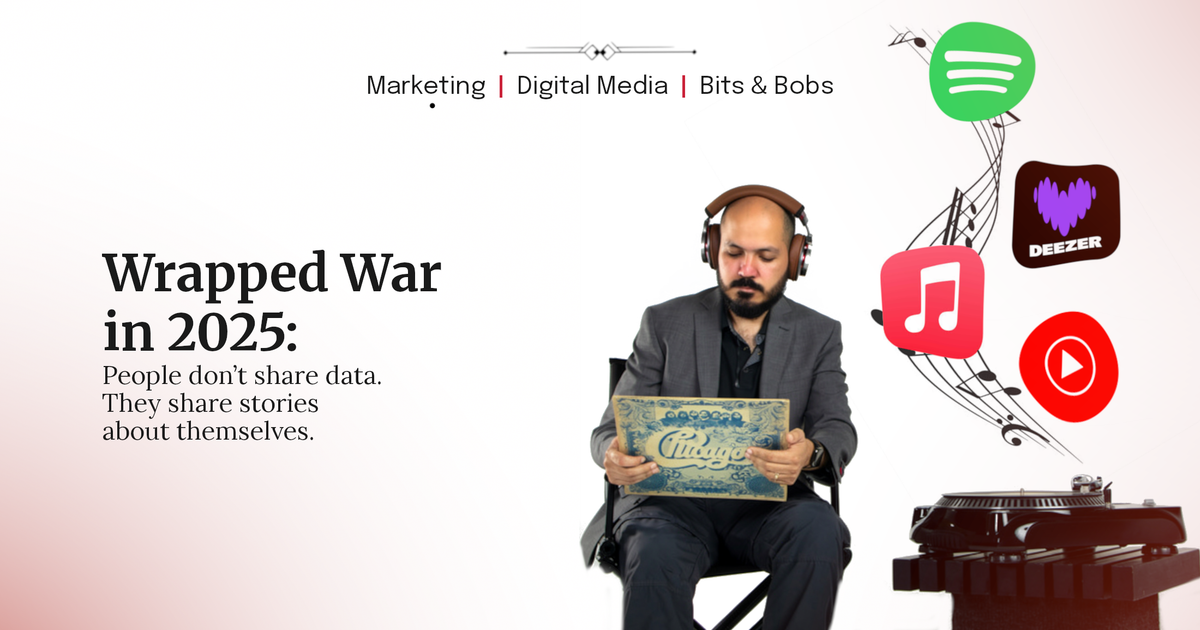
People don’t share data. They share stories about themselves.
That’s the real magic behind things like Spotify Wrapped, not the charts or the numbers, but the feeling of “this is so me” on a brightly coloured screen.
The Battle of the Music Apps (From a Quiet Deezer Corner)
December in Dublin, you’re in a café with a chai, and suddenly your feeds turn into a war zone. Not politics. Not football. Spotify Wrapped.
Everyone is posting neon-coloured grids, “Top 0.05% fan” badges, and maps of all the genres they “discovered” this year. It’s chaos, but beautiful chaos.
Meanwhile, Apple Music users quietly open Apple Music Replay. Everything is clean, polished, minimalist. The kind of design that feels like it came out of a meeting with ten UX designers and one lawyer.
And somewhere in the back, there’s the Deezer and YouTube Music crew. No war. No aesthetic flood. Just people listening to their playlists in peace, occasionally wondering if they should feel left out… and then pressing play again.

Spotify: 700 Million Free Billboards
Spotify didn’t just release a feature. It built an annual ritual.
Every year, Wrapped turns listeners into free billboards:
- Screenshots on Instagram stories
- “Look how chaotic my top 5 is” posts
- Group chats comparing who listened to the most niche artist
It’s genius because it taps into ego, identity and belonging. Wrapped says:
- “You’re unique.”
- “You’re part of something.”
- “You’re the kind of person who listens to this.”
Spotify isn’t really saying, “Here’s your data.”
It’s saying, “Here’s a story about who you are.”
And that’s why people share it.

Apple Music: Clean, Polished… and a Bit Safe
Now slide over to Apple Music Replay. Clean. Polished. Very on-brand.
The design is slick, the numbers are accurate, the whole thing looks like it was approved by twelve people in a glass boardroom. It’s solid.
But here’s the problem: it often feels more like a report than a party.
It’s:
- Great for organising your listening stats
- Less great for making you feel something worth posting
It’s the difference between:
- A colourful, chaotic yearbook full of doodles (Spotify / YouTube Recap)
versus - A tidy spreadsheet that tells the truth but doesn’t inspire a screenshot
And nobody rushes to share a spreadsheet.

YouTube Music: The Underdog With a Story
Then there’s YouTube Music Recap.
It leans into visuals and personality too:
- Collages of moods
- Artist cards
- Shareable recap formats
It knows the game: make it easy to tap “Share” and say,
“This is me. This is my year. This is my vibe.”
Again, the power isn’t the accuracy of the data.
It’s the way it turns that data into something that feels like a personal highlight reel.

Deezer: High-Fidelity and Peace and Quiet
And finally, the quiet kid at the back of the class: Deezer.
No wars in the group chat. No “wrapped panic”. Just:
- High-fidelity audio
- A calmer experience
- You, and your obscure B-sides, minding your business
On the surface, it might seem like Deezer “loses” in the shareability race. But it serves a different kind of user:
- People who care more about sound than social
- People who don’t need their listening habits turned into content every year
And that’s a lesson in itself: not every brand needs to chase virality. But every brand still needs to understand what its users actually care about.

So What’s the Real Lesson Here?
All these platforms are working with basically the same raw material: your listening data.
But they package it very differently.
The real takeaway:
Wrapped, Replay, Recap—these work when they:
- Reflect identity (“I’m the kind of person who listens to this”)
- Spark conversation (“Your top artist is WHO?”)
- Create a ritual (“It’s Wrapped season, everyone post your chaos”)
Underneath all the fancy animations, it’s simple:
- Emotion > perfection
- Story > stats
What This Means for Your Brand
You don’t need to build the Spotify of your industry to apply this. You can steal the principle.
When you think about your own marketing, ask:
- Are you giving people a story to share, or just information?
- Are you creating moments that feel like, “This is so me, I have to show someone”?
- Is your brand a mirror… or just a report?
Some practical ways to bring this into your own work:
- Turn testimonials into little stories, not just star ratings
- Show transformations, not just features
- Wrap your year, your project, or your client work in a narrative, not a spreadsheet
Because whether it’s Spotify Wrapped, Apple Music Replay, YouTube Music Recap, or a quiet Deezer session, the platforms that win attention are the ones that help people say:
“This is who I am.”
Now, if you’ll excuse it, somewhere, a forgotten B-side needs to be played. Cheers.