A Reader Asked Me About Late Payments
Most late payments aren't actually about the payment itself. They are symptoms of two bigger mistakes made before the work even starts:

Here's What I Told Him:
The Story
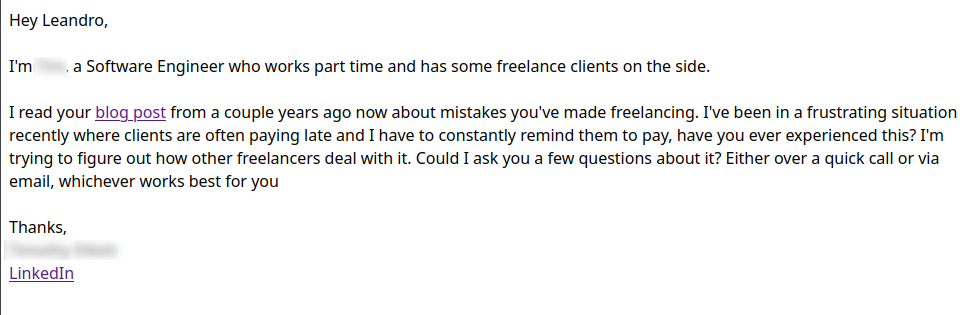
I recently received an email from a reader — a software engineer who's been freelancing on the side. He's doing great work, but he hit a wall that every freelancer eventually faces: a client who just won't pay on time.
He asked me how I handle it. This was my response to him, and I think it's something we all need to hear.
The Two Main Mistakes
Most late payments aren't actually about the payment itself. They are symptoms of two bigger mistakes made before the work even starts:
Working with the Wrong Clients
If you are chasing payments from a client who is constantly "checking with accounting" or "waiting for a transfer," you probably shouldn't have been working with them in the first place. Bad clients reveal themselves early: they haggle on price, they don't respect your time, and they treat your invoice as a suggestion rather than a legal obligation.
Working Without a Contract
If you don't have a signed contract that explicitly states your payment terms, you don't have a late payment problem — you have a legal problem. A contract is your shield. It defines when you get paid, how you get paid, and what happens if you don't.

The "Leandro" System for Getting Paid
Here are the specific tactics I use to keep my cash flow healthy (you can adapt it later for yourself):
- Net 7 or Net 14 Terms: Stop giving 30-day terms. Small businesses need cash flow. I prefer Net 7. If they can't pay in a week, they shouldn't be hiring me.
- Immediate Invoicing: I send the invoice the moment the milestone is hit. Not at the end of the month. Not "when I get around to it."
- Late Fee Clauses: My contracts include a 5% late fee for every week the payment is overdue. I rarely have to enforce it, because the mere existence of the clause makes clients prioritize my invoice.
- Deposit First: For any project over €500, I require a 50% deposit before I even open my laptop. This ensures the client has skin in the game.
The Tools I Use
Don't manually track invoices in a spreadsheet. Use tools that automate the awkwardness:
Revolut / Stripe / Wise: For clean, fast, professional invoicing and global payments.
Contra: For integrated contracts and project management. This is where I spend most of my time, the guys at Contra made it really good and easy to use.
Notion: To track my pipeline and see exactly who owes what at a glance.

The Real Solution: Prospecting
Here's what changed everything for me.
I stopped waiting for clients to find me and started choosing who I wanted to work with. That one shift fixed almost every payment problem I had.
When you prospect, when you reach out to the businesses you actually want to serve you set the tone from the very first conversation. You're not desperate for the gig. You're not saying yes to anyone with a budget. You're selecting people who value what you do, respect your process, and understand that paying on time is not a favour - it's part of the deal.
I started targeting specific types of businesses: hospitality, local brands, people who needed content but didn't have the time or skills to create it themselves. I built content around their problems. I showed up in their feeds with useful ideas. And when they were ready to hire someone, I was already the obvious choice.
The result? Better clients. Clearer communication. Faster payments. And honestly, way more enjoyable work.
So if you're stuck in a cycle of chasing invoices, the answer isn't a better payment reminder: it's a better client. And the way to get better clients is to stop being chosen and start choosing.
Final Thought
Late payments are a process problem, not a "part of the job." If you fix your process, you fix your life.
If you found this helpful, I share one deep-dive into the business of creativity every week in my newsletter.
No spam. Unsubscribe anytime.